For more than a decade, many internet service providers treated IPTV as a defensive necessity rather than a real business opportunity. The primary goal was simple: offer a television service so that broadband customers would not leave for pure over-the-top platforms. In most cases, IPTV was priced low, packaged rigidly, and operated with relatively little commercial ambition.
That era is ending.
The ISPs that are growing revenue and improving margins in 2026 have fundamentally changed their approach. They no longer view IPTV as a cost center or a retention tool alone. Instead, they treat it as a full product line with its own packaging strategy, pricing logic, revenue targets, and growth roadmap. The difference in outcomes between these two mindsets is significant.
This article examines the practical monetization models that are working for ISPs today, the operational capabilities required to support them, and why the underlying platform architecture plays a decisive role in how much revenue can actually be captured.
The Shift from Defensive to Offensive IPTV
When IPTV is treated only as a defensive product, commercial decisions tend to be conservative. Packages change rarely, pricing remains static for long periods, and new content deals are approached cautiously because the operational cost of implementing them is high. In this model, IPTV generates some revenue, but it rarely becomes a meaningful contributor to overall company performance.
Operators who have moved to an offensive posture behave differently. They experiment with packaging, test new price points, introduce limited-time offers, and actively look for additional revenue streams beyond the basic subscription. They also measure IPTV performance with the same rigor they apply to broadband — looking at average revenue per user, churn impact, and contribution margin.
The operators achieving the best results share one important characteristic: their platform makes commercial experimentation relatively easy instead of expensive and slow.
1. Flexible and Dynamic Content Packaging
The foundation of effective IPTV monetization is packaging. The ability to create, modify, and retire content packages quickly is one of the highest-leverage capabilities an ISP can possess.
Traditional systems often make packaging changes difficult. Adding a new sports tier, creating a temporary movie package for the holiday season, or adjusting the content mix of an existing bundle can require coordination across multiple teams and systems. When the cost of change is high, change happens rarely.
Modern platforms reverse this dynamic. When packaging is treated as a configuration task rather than a development project, commercial teams gain the freedom to respond to market conditions, seasonal demand, and competitor moves. This flexibility directly translates into higher revenue capture.
Successful ISPs typically maintain a core set of evergreen packages while regularly testing tactical offers. The operational requirement is a system that allows these changes to be implemented quickly and cleanly, with automatic updates to entitlements and billing.
2. Pay-Per-View and Event-Based Revenue
Linear subscriptions form the base of most IPTV businesses, but they are not the only opportunity. High-value live events — major sports finals, boxing matches, concerts, and exclusive broadcasts — create natural opportunities for transactional revenue.
Pay-per-view works best when two conditions are met. First, the purchase process must be frictionless for the customer. Second, entitlement must be automatic and reliable once payment is completed. Any delay or manual step reduces conversion and increases support load.
ISPs that successfully monetize events usually integrate pay-per-view deeply into both the electronic program guide and the player experience. Customers can discover the event, purchase it, and start watching without leaving the viewing environment. The platform must support time-limited entitlements cleanly and report performance accurately.
3. Advertising as a Complementary Revenue Stream
Subscription revenue is predictable, but it is not the only model available. When an IPTV platform supports dynamic advertising, a second revenue stream becomes possible.
Server-side ad insertion on linear channels and targeted placements on the home screen allow operators to generate income from advertisers without increasing the price paid by subscribers. Local advertising is particularly attractive for ISPs because they already possess valuable data about subscriber location and service tier.
The technical requirement is a platform that can handle dynamic ad insertion reliably while maintaining a high-quality viewing experience across both multicast and unicast delivery. When advertising is bolted on as an afterthought, the viewer experience often suffers and fill rates remain low. When it is designed into the platform, it becomes a meaningful contributor to overall revenue.
4. Bundling with Broadband and Multi-Play Offers
For most ISPs, the strongest commercial model remains the bundle. IPTV becomes significantly more valuable when it is positioned as part of a higher-tier broadband or multi-play package.
In this model, the television service is not sold in isolation. It becomes one of the reasons a customer chooses a more expensive broadband plan and stays with the provider longer. The impact on customer lifetime value can be substantial, even if the standalone IPTV margin appears modest.
Effective bundling requires tight integration between the IPTV platform and the ISP’s business support systems. Provisioning, suspension, package changes, and cancellation must flow automatically. When these processes remain manual, the operational cost of bundling erodes much of the commercial benefit.
5. White-Label and B2B Opportunities
Some of the highest-margin revenue available to ISPs comes from offering their IPTV platform to third parties under a white-label model. Hotels, residential complex operators, smaller regional providers, and even other ISPs can become customers.
This model only works at scale when the platform supports true multi-tenancy. Each client needs independent branding, content packaging, subscriber management, and reporting, while the ISP retains centralized control and visibility. Platforms that lack proper multi-tenancy force operators into complex and fragile workarounds that limit growth.
ISPs that have successfully built a white-label business typically treat it as a distinct product line with its own sales process, onboarding workflow, and support model. The underlying technology must make onboarding new tenants fast and reliable.
The Role of Platform Architecture in Monetization
All of the monetization models described above share a common dependency: the underlying platform must make packaging, entitlement, advertising, reporting, and multi-tenancy relatively easy to manage. When these capabilities are difficult or slow, commercial ambition is constrained by operational reality.
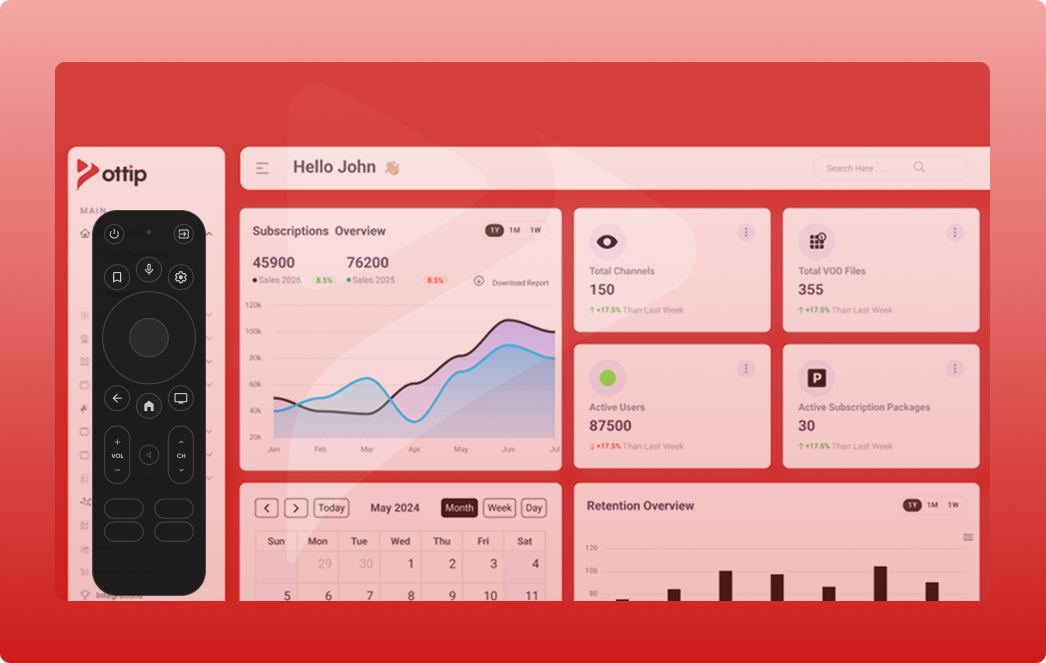
This is the core problem Ottip was designed to solve. The platform provides flexible package management, clean pay-per-view support, advertising readiness, robust multi-tenancy, and unified reporting in a single system. As a result, commercial teams can pursue revenue opportunities without constantly negotiating with technical limitations.
Operators using Ottip are able to test new packages quickly, launch event-based offers with minimal effort, and onboard white-label clients without building custom infrastructure for each one. This operational leverage directly improves the economics of IPTV.
Measuring What Matters
Monetization cannot improve without measurement. Leading ISPs track not only total IPTV revenue, but also contribution margin, package uptake rates, pay-per-view conversion, advertising fill and yield, and the impact of IPTV on broadband churn and average revenue per user.
A platform that consolidates these metrics into clear, accessible reports gives commercial and executive teams the visibility they need to make informed decisions. When data is scattered across multiple systems, analysis becomes slow and incomplete.
Conclusion: From Cost Center to Growth Engine
IPTV does not have to remain a low-margin defensive product. With the right packaging flexibility, event monetization capabilities, advertising support, bundling strategy, and white-label potential, it can become a meaningful contributor to an ISP’s overall financial performance.
The limiting factor is rarely market demand. In most cases, it is the operational difficulty of executing commercial ideas. Platforms that reduce this friction unlock revenue that was previously left on the table.
Ottip exists to remove that friction. By making advanced monetization models operationally practical, it allows ISPs to move from a defensive posture to a genuine growth strategy for their television service.
Ready to unlock the full revenue potential of your IPTV service?
Schedule a monetization strategy session with our team. We will review your current setup and show you concrete opportunities that operators similar to you are already capturing with Ottip.