
One of the most important architectural decisions in any IPTV or hybrid OTT deployment is how video will be delivered from the headend to the end user. The two dominant models, multicast and unicast, differ fundamentally in how they consume network resources, how they scale, how they handle failures, and what operational capabilities they enable. Choosing the wrong model for a given environment creates lasting consequences: unnecessary bandwidth costs, limited scalability, poor channel-change performance, or an inability to support key commercial features. Choosing well, on the other hand, allows an operator to maximize efficiency where it matters while retaining flexibility where it is required.
This article provides a detailed technical comparison of multicast and unicast delivery for IPTV services. It is written for network engineers, architects, and technical decision-makers who need to evaluate which approach or combination of approaches, best fits their infrastructure and business goals.
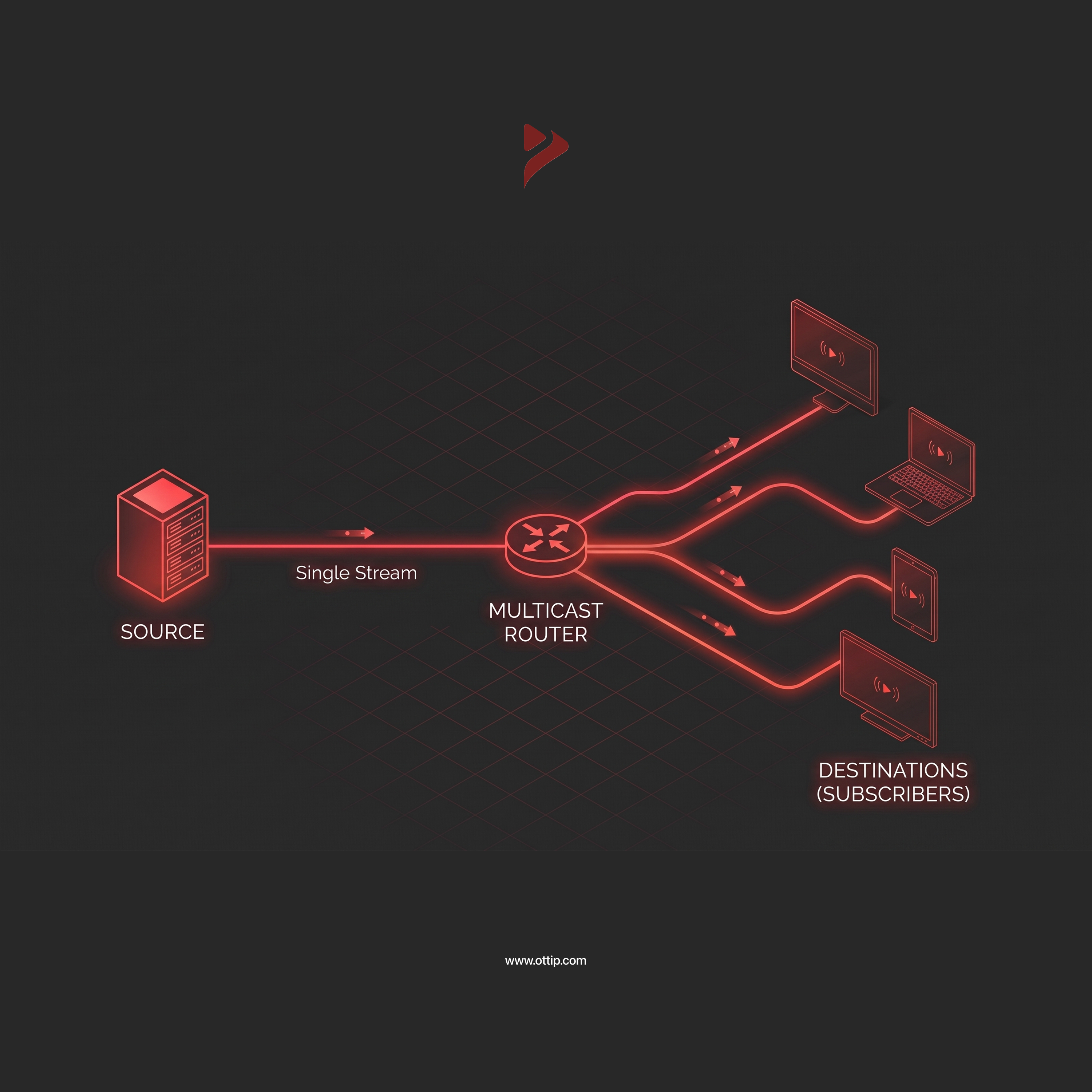
Understanding Multicast Delivery
In a multicast model, a single copy of a live stream is sent from the source into the network. Routers and switches that support IP multicast (using protocols such as IGMP and PIM) replicate the stream only where it is needed, creating a distribution tree. When a new viewer joins a channel, an IGMP membership report travels upstream, and the network adds the appropriate branch so that the stream reaches the new client without requiring an additional full copy from the origin.
The efficiency advantage is substantial. A single high-bitrate linear channel can serve thousands of concurrent viewers while consuming roughly the same core and aggregation bandwidth as one unicast stream. This characteristic is why multicast remains the preferred delivery method for managed IPTV networks operated by ISPs, cable operators, and other providers who control the access network.
Multicast does, however, impose requirements. The entire path from headend to customer premises equipment must support multicast routing. IGMP snooping must be correctly configured on access switches to prevent unnecessary flooding. Multicast routing policies (ASM or SSM) need to be defined and maintained. And because many viewers share the same stream, any packet loss or network impairment affects all viewers on that branch of the distribution tree..
Channel-change performance in multicast environments is typically excellent once the stream is present in the network, because the client can join an already-flowing stream rather than initiating a new end-to-end session.
Understanding Unicast Delivery
Unicast treats every viewer as an independent session. The origin or CDN edge sends a dedicated stream to each client. Modern implementations almost always use adaptive bitrate protocols such as HLS or DASH, allowing the player to request the quality level that matches current network conditions. This model scales horizontally through CDN capacity rather than through network-level replication. It works across the public internet, behind NAT, on mobile networks, and in any environment where the operator does not control the intermediate routers. Because each session is independent, per-user features such as personalized advertising, individual DRM licenses, detailed analytics, and dynamic quality adjustment are straightforward to implement.
The trade-off is bandwidth consumption. If one thousand viewers watch the same 8 Mbps channel, the network must carry approximately 8 Gbps of traffic. At scale this becomes expensive in terms of transit costs, peering capacity, and CDN usage. Origin shielding, aggressive edge caching, and intelligent request routing can significantly improve efficiency, but they cannot eliminate the fundamental linear relationship between concurrent viewers and bandwidth.
Channel-change times in unicast environments are generally longer than in well-tuned multicast networks because each change involves session setup, playlist retrieval, and buffer filling.
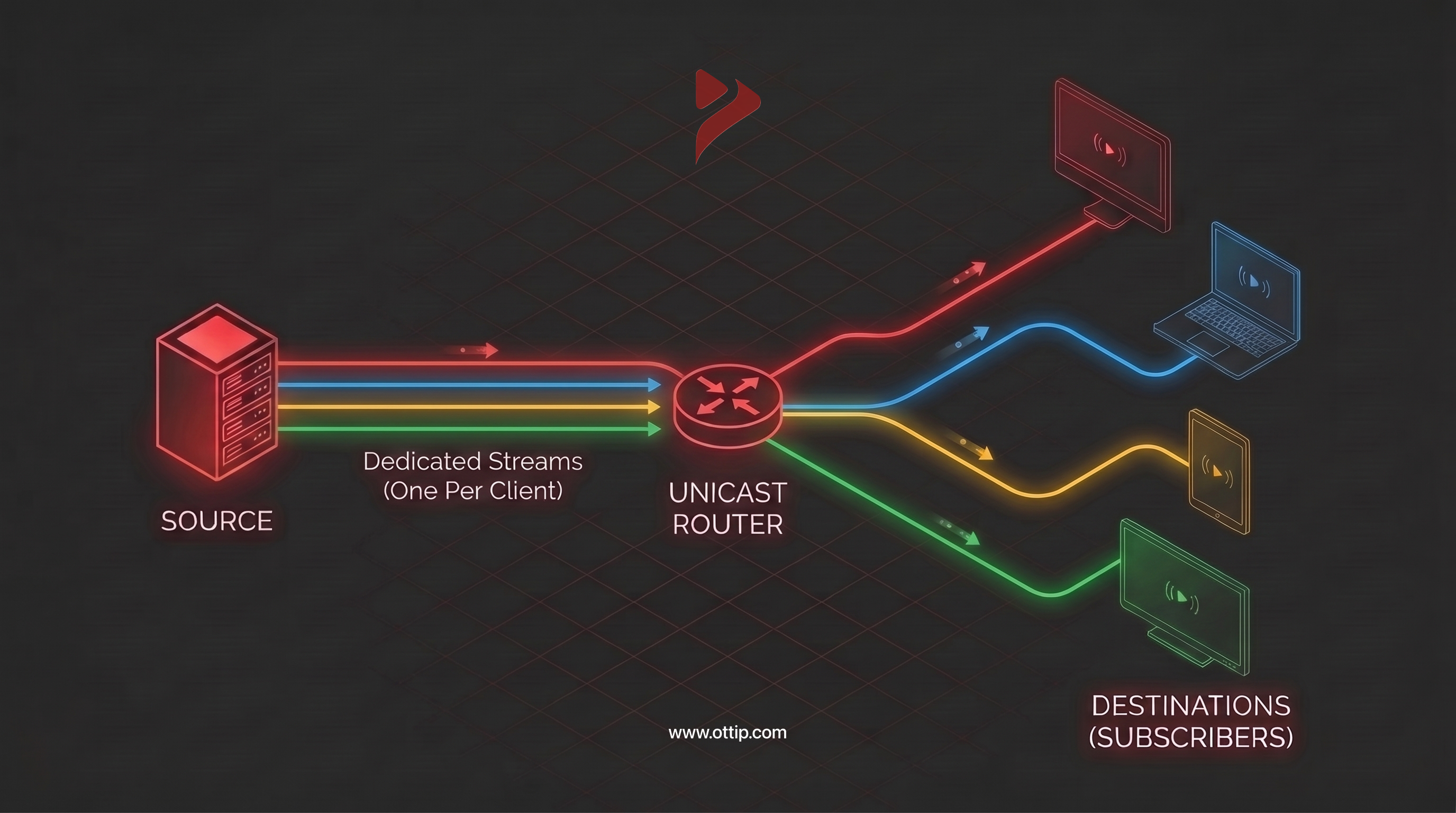
Bandwidth and Efficiency Comparison
From a pure network-efficiency perspective, multicast is almost always superior for high-concurrency linear content inside a controlled network. The bandwidth curve is essentially flat once the stream has been injected into the core. Adding more viewers does not produce a proportional increase in core traffic.
Unicast scales linearly with the number of concurrent sessions. Its efficiency depends heavily on caching effectiveness and the degree of content popularity concentration. For long-tail content or highly fragmented viewing, the efficiency gap narrows. For popular live channels watched simultaneously by large audiences, the gap is large.
In practice, most operators observe that a relatively small number of linear channels account for a large percentage of concurrent viewership. These channels are the strongest candidates for multicast. Everything else, VOD, catch-up, long-tail linear, and off-net viewing — is typically better served by unicast.
Operational and Feature Trade-offs
Beyond raw bandwidth, the two models differ in several operationally important ways.
Latency and channel change Multicast generally offers lower glass-to-glass latency and faster channel zapping when the network is properly designed. Unicast channel changes involve more signaling and buffering steps.
Error recovery and quality Unicast benefits from per-session recovery mechanisms and the player’s ability to drop to a lower bitrate or request missing segments. Multicast error recovery is more limited and usually relies on forward error correction or network-level resilience.
Monitoring and analytics Unicast sessions are inherently easier to instrument at the individual viewer level. Multicast monitoring relies more heavily on network telemetry (IGMP joins/leaves, traffic counters, probe-based quality measurements) and is often less granular.
Security and access control Unicast integrates naturally with token-based authentication, fine-grained geo-blocking, and concurrent-stream limits. Multicast access control is typically enforced at the network edge through subscriber provisioning and IGMP filtering, which is less dynamic.
Personalization and advertising Dynamic ad insertion, personalized recommendations, and per-user content variation are significantly easier in a unicast environment.
When Multicast Is the Clear Choice
Multicast is usually the better primary model when:
- The operator controls the access network (FTTH, DOCSIS, carrier-managed Wi-Fi, etc.)
- A significant share of concurrent viewing is concentrated on a limited set of linear channels.
- Bandwidth in the core and aggregation layers is constrained or expensive.
- Fast channel change and consistent quality are high priorities.
- The service is primarily linear rather than on-demand heavy.
Classic ISP IPTV deployments, hospitality networks, and closed campus environments frequently fall into this category.
When Unicast Is Required or Preferable
Unicast becomes necessary or preferable when:
- Viewers reach the service over the public internet or mobile networks
- The service includes a substantial VOD or catch-up component.
- Per-user features (personalization, dynamic advertising, individual analytics) are important.
- The operator cannot guarantee multicast support across the delivery path.
- Rapid feature iteration and cloud-based scaling are priorities.
Most pure OTT services and any hybrid service that must reach off-net customers rely heavily on unicast.
The Hybrid Reality
In practice, the cleanest architectures rarely choose only one model. A common and effective pattern is to use multicast for high-concurrency linear channels inside the managed network, while automatically falling back to unicast for the same channels when the client is off-net or when multicast is unavailable. All VOD, catch-up, and long-tail content remains unicast.
The operational challenge in hybrid environments is consistency. Channel numbering, EPG data, encryption keys, entitlements, and analytics must remain aligned across both delivery paths. When these elements are managed in separate systems, complexity and error rates rise sharply.
How Ottip Supports Both Models
Ottip is designed so that the same channel configuration, packaging logic, and entitlement rules can feed both multicast and unicast delivery. Operators define a channel once, including source, numbering, category, EPG mapping, and security parameters and then enable the appropriate output methods.
Multicast groups can be announced into the managed network while adaptive bitrate unicast packages are published to the origin or CDN. When a client cannot join the multicast stream, it can request the unicast equivalent without the subscriber experiencing a different service. Analytics from both paths are consolidated, giving network and commercial teams a unified view of performance and usage.
This dual-delivery capability removes the need to maintain parallel headends or separate middleware instances for on-net and off-net users. It also simplifies long-term evolution: as more of the access footprint becomes multicast-capable, traffic can be shifted from unicast to multicast without re-architecting the content preparation or subscriber management layers.
Conclusion: Match the Model to the Network and the Product
There is no universal winner between multicast and unicast. The correct choice depends on the operator’s network footprint, viewing patterns, feature requirements, and commercial model.
Operators who control a managed access network and serve high concurrent audiences for linear channels will almost always benefit from multicast as the primary delivery method for those channels. Operators who must reach users across the open internet, who emphasize on-demand and personalized experiences, or who lack multicast support in the network will rely primarily on unicast.
The most capable platforms allow both models to coexist cleanly, using the same channel definitions, entitlements, and analytics. This is the approach Ottip takes — enabling operators to apply the right delivery method in each context without fragmenting their operational or commercial systems.
Need help evaluating the right delivery architecture for your network?
Talk to our network architects. We can review your current infrastructure and viewing patterns and provide a clear recommendation, including how Ottip can support a pure multicast, pure unicast, or hybrid model.