In the early days of IPTV and OTT, content aggregation was often treated as a secondary concern. Operators focused on acquiring channels, signing VOD deals, and launching a player. The actual work of bringing those sources into a coherent, manageable system was frequently handled through a patchwork of scripts, manual processes, and disconnected tools.
That approach no longer scales.
As the number of content sources grows, as EPG expectations rise, and as commercial packaging becomes more dynamic, fragmented aggregation turns into a significant operational burden. New channels take too long to launch. EPG data is inconsistent. VOD libraries become difficult to manage. And every commercial change requires coordination across multiple systems.
This article examines why unified content aggregation has become a strategic capability, what a modern aggregation layer must deliver, and how leading operators are reducing complexity while increasing speed and reliability.
The Hidden Cost of Fragmented Content Management
Most operators do not create the majority of their content. They aggregate it. Live channels arrive from satellite, terrestrial, fiber contribution links, and IP sources. EPG data comes from multiple providers in different formats and time zones. VOD content arrives from studios, aggregators, and internal libraries, often with incomplete or inconsistent metadata.
When each of these domains is managed in a separate tool, the operational overhead compounds quickly. Launching a new wholesale channel provider can require updates in the streaming system, the EPG system, the packaging layer, and the middleware. Correcting an EPG mapping issue may involve multiple teams. Adding a new VOD collection can trigger a chain of manual steps.
The result is slower time-to-market, higher error rates, and a growing dependence on tribal knowledge. Over time, the cost of maintaining this fragmented environment exceeds the cost of implementing a proper aggregation layer.
What Modern Content Aggregation Must Deliver
A production-grade content aggregation system must address several core requirements simultaneously.
Flexible live source ingestion. This includes IP streams (HLS, MPEG-TS, SRT, RTMP), contribution feeds, and the ability to import existing lineups from Xtream Codes or M3U sources when migrating or consolidating providers. Each source should support monitoring, failover, and clean mapping into logical channel numbers and categories.
Robust EPG handling. The system should support scheduled XMLTV imports, multiple time zones, multiple languages, manual overrides, and a built-in EPG builder for channels that lack an external feed. Matching external EPG channel identifiers to internal streams must be reliable and auditable. Poor EPG quality is one of the fastest ways to damage viewer trust.
Normalized VOD aggregation. VOD aggregation must normalize content from diverse sources into a consistent model of titles, series, seasons, and episodes. Metadata enrichment (commonly via services such as TMDB) should be automated where possible, while still allowing manual control for regional titles, custom artwork, or corrected descriptions. Transcoding and packaging should be triggered as part of the same workflow so that content becomes playable without additional manual intervention.
Dual delivery. The same channel configuration should be available for both multicast injection into managed networks and unicast packaging for CDN or OTT delivery. Maintaining separate channel lists for each delivery method creates unnecessary risk and effort.
Operational visibility. Operators need a clear view of source health, EPG coverage, VOD processing status, and overall lineup integrity from a single interface.
The Strategic Advantage of Unification
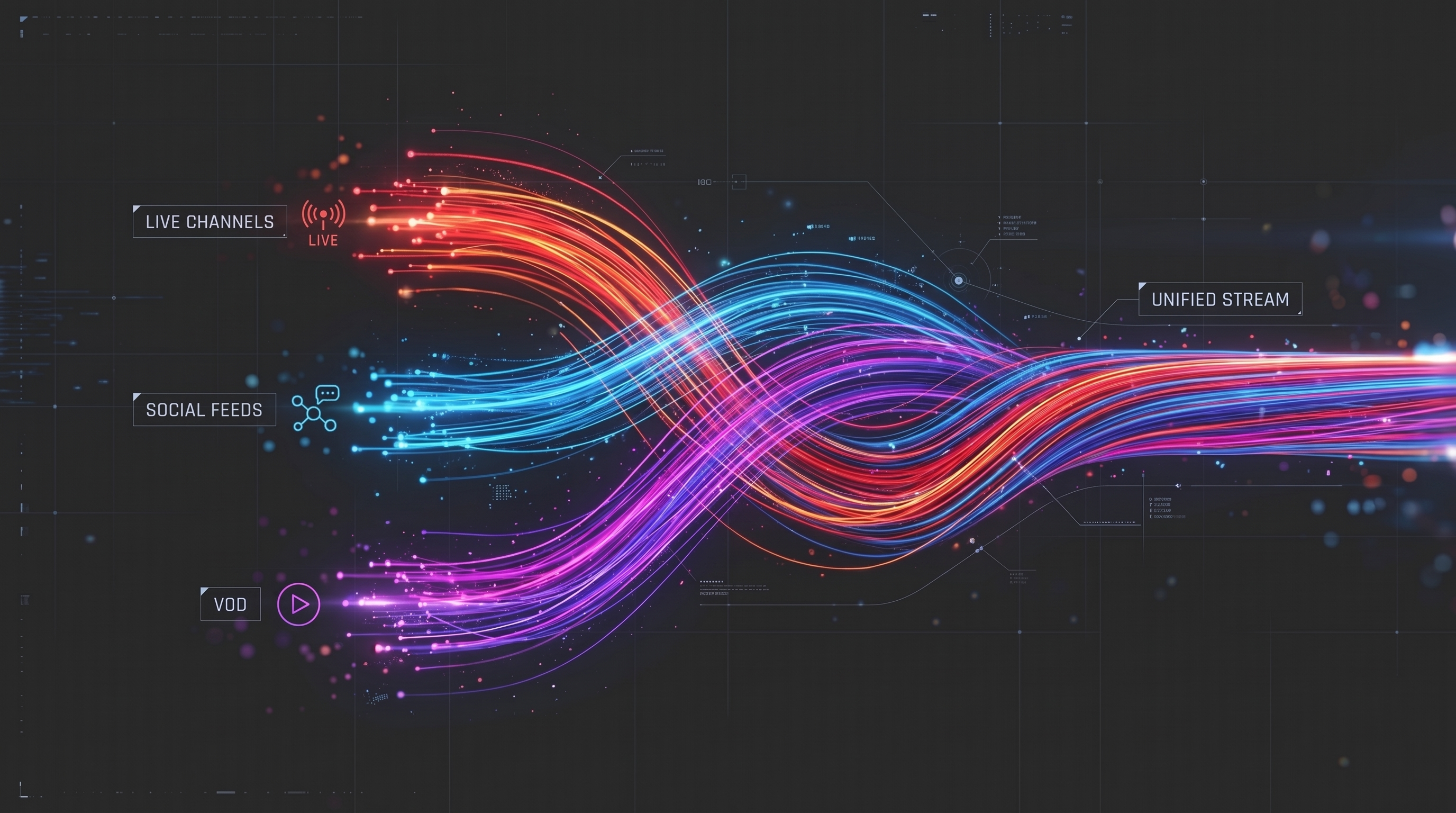
When live channels, EPG, and VOD are managed within a unified aggregation layer, several important benefits emerge.
Time-to-launch for new sources decreases dramatically. What previously required coordination across multiple systems becomes a structured workflow within one platform. Commercial teams gain the ability to create and adjust packages more quickly because the underlying content is already normalized and available.
Error rates decline because there are fewer hand-offs between systems. EPG mappings, channel numbering, and content metadata remain consistent. And because monitoring is centralized, problems are detected earlier and resolved faster.
Perhaps most importantly, the organization reduces its dependence on fragile custom integrations and specialized knowledge. New team members can become productive more quickly, and the overall system becomes easier to evolve.
Migration and Consolidation Use Cases
Unified aggregation is particularly valuable during migration or consolidation projects. Operators moving from legacy middleware, combining multiple smaller platforms, or onboarding new wholesale providers face significant complexity when content is fragmented.
Bulk import capabilities for Xtream Codes and M3U sources, combined with intelligent category mapping and duplicate handling, can reduce a multi-week manual effort into a controlled process that completes in days. The same tools remain useful for ongoing operations as content deals change and new providers are added.
How Ottip Approaches Content Aggregation
Ottip treats content aggregation as a core platform capability rather than an add-on. Live sources, EPG data, and VOD libraries are managed within a single coherent system. Channels can be configured once and then delivered via both multicast and unicast. EPG import, mapping, and maintenance are designed for reliability at scale. VOD ingestion includes metadata enrichment and automated preparation for delivery.
Operational visibility is built in, giving teams a clear view of source health and content status. And because aggregation sits inside the same platform that handles packaging, entitlement, and multi-tenancy, commercial and operational changes remain aligned.
This integrated design is one of the reasons operators choose Ottip when they want to reduce complexity while increasing the speed and reliability of their content operations.
Conclusion: Aggregation as Infrastructure
Content aggregation is no longer a background technical function. It is a foundational layer that directly influences time-to-market, operational cost, viewer experience, and commercial flexibility.
Operators who continue to manage live channels, EPG, and VOD through disconnected tools will face growing friction as their services become more complex. Those who invest in a unified aggregation layer gain the ability to move faster, operate more reliably, and adapt more easily to changing content and commercial requirements.
Ready to eliminate fragmented content workflows?
Request a technical walkthrough of Ottip's content aggregation capabilities and see how operators are simplifying their operations while accelerating new source launches.