The television in a hotel room has always been part of the guest experience, but for most of its history it played a relatively passive role. Guests expected a selection of linear channels, a basic electronic program guide, and little else. As long as the picture was clear and the remote worked, the system was considered adequate.
That standard is no longer sufficient.
Today's hotel guests arrive with very different expectations. They are used to personalized interfaces, on-demand content, seamless device integration, and services that respond to their preferences. When the in-room television fails to meet these expectations, it does not merely disappoint — it actively lowers the perceived quality of the entire stay. Conversely, when the entertainment system feels modern, personal, and useful, it becomes a quiet but meaningful contributor to guest satisfaction and, in many cases, to ancillary revenue.
This article examines how hotel guest entertainment is evolving, what leading hotel groups are implementing, and why the underlying technology platform has become a strategic decision rather than a pure facilities choice.
The Limitations of Legacy Hotel TV Systems
Most traditional hotel television systems were designed around a simple model: a fixed channel lineup, a standard welcome screen, and limited interactivity. Content was largely the same for every guest, personalization was minimal or non-existent, and integration with other hotel systems was shallow or absent.
These systems were adequate in an era when guests had fewer alternatives and lower expectations. They are increasingly inadequate today. Common problems include:
- Generic welcome screens that ignore guest name, language, and loyalty status
- Limited or outdated on-demand libraries
- No ability for guests to order services directly from the television
- Difficulty managing consistent experiences across multiple properties
- High operational overhead when content or branding needs to change
Hotel groups that continue to rely on these legacy architectures are not only missing opportunities to improve the guest experience, they are also leaving potential revenue on the table.
Personalization as the New Baseline
The most visible shift in modern hotel entertainment is personalization. When a guest checks in, the system should already know who they are. The welcome screen can greet them by name, appear in their preferred language, and reflect their loyalty tier. Relevant offers, local recommendations, and content highlights can be tailored accordingly.
This level of personalization is only possible with deep, real-time integration between the entertainment platform and the hotel's Property Management System (PMS). When the two systems exchange data reliably, the television stops being a generic device and becomes an extension of the guest's stay.
Leading hotel groups have found that even relatively simple personalization, using the guest's name and language, produces a noticeably more premium feeling. More advanced implementations layer in loyalty recognition, stay-specific offers, and content recommendations based on guest profile or previous behavior.
Content Expectations Have Changed
Modern guests expect more than a list of linear channels. They want a strong mix of live television and on-demand content, including movies, series, and catch-up. They also expect the experience to feel current. Outdated interfaces, slow navigation, and limited catalogs quickly undermine the sense of quality.
At the same time, hotels must balance guest expectations with practical constraints. Bandwidth, licensing, and operational complexity all play a role. The most effective platforms allow hotels to offer a compelling content mix while still controlling costs and maintaining reliability. Hybrid delivery models — using multicast for high-concurrency linear channels and unicast for on-demand and personalized content — are increasingly common in well-designed deployments.
The Television as a Service Portal
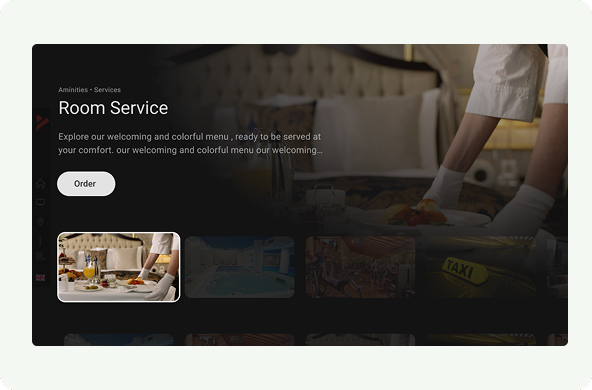
One of the most significant evolutions is the transformation of the television from a pure entertainment device into a service interface. Guests can browse room service menus, book spa appointments, make restaurant reservations, request housekeeping, or explore local experiences without picking up the phone or opening a separate app.
When these capabilities are implemented well, they deliver benefits on multiple levels. Guests enjoy greater convenience. Hotel staff experience reduced call volume for routine requests. And the hotel gains an additional channel for promoting higher-margin services.
The technical requirement is a platform that can integrate cleanly with existing hotel operational systems and present service options in a way that feels native to the television experience rather than like a bolted-on web page.
Managing Multiple Properties at Scale
For hotel groups and management companies, the challenge is not limited to a single property. The real difficulty lies in delivering consistent yet locally relevant experiences across dozens or hundreds of hotels while maintaining centralized control.
Legacy systems often force a painful trade-off. Either every property runs largely independently (creating inconsistency and high support costs), or a rigid central system is imposed (limiting local flexibility and brand differentiation).
Modern platforms resolve this tension through true multi-tenancy. Each property can have its own branding, content package, welcome flow, and service configuration, while the group retains a single control plane for monitoring, updates, reporting, and strategic oversight. This architectural approach is becoming a decisive factor for hotel groups evaluating new entertainment systems.
The Strategic Role of the Platform
The quality of the guest entertainment experience is no longer determined primarily by the television hardware. It is determined by the software platform that sits behind it. The platform governs personalization, content flexibility, service integration, multi-property management, and the ability to evolve the experience over time without repeated large-scale replacements.
Hotels and hotel groups that treat the entertainment platform as a strategic layer rather than a commodity facilities decision are better positioned to meet rising guest expectations and to extract additional value from the in-room screen.
How Ottip Supports Modern Hotel Entertainment
Ottip was designed with hospitality and multi-property environments as core use cases. The platform supports both Hotel and Residential experience modes, offers deep PMS integration for personalization, enables on-screen service ordering, and provides true multi-property management with clean brand and content isolation.
Operators can deliver a premium, personalized experience at each property while retaining centralized visibility and control. Content can be delivered efficiently using both multicast and unicast methods according to the network environment. And because the system is designed for ongoing evolution, hotels can continue to improve the guest experience without replacing the underlying platform.
Conclusion: From Utility to Experience Layer
The in-room television is undergoing a quiet but important transformation. What was once a basic utility is becoming an integrated layer of the guest experience, one that can influence satisfaction, simplify operations, and contribute to ancillary revenue.
Hotel groups that recognize this shift and invest in platforms capable of supporting personalization, service integration, and scalable multi-property management will be better positioned to meet the expectations of modern travelers. Those that continue to rely on outdated, rigid systems risk falling behind both in guest perception and in operational efficiency.
Ready to modernize guest entertainment across your properties?
Schedule a hospitality-focused demo with our team. We will show you how Ottip is already helping hotel groups deliver personalized, high-quality in-room experiences at scale.